
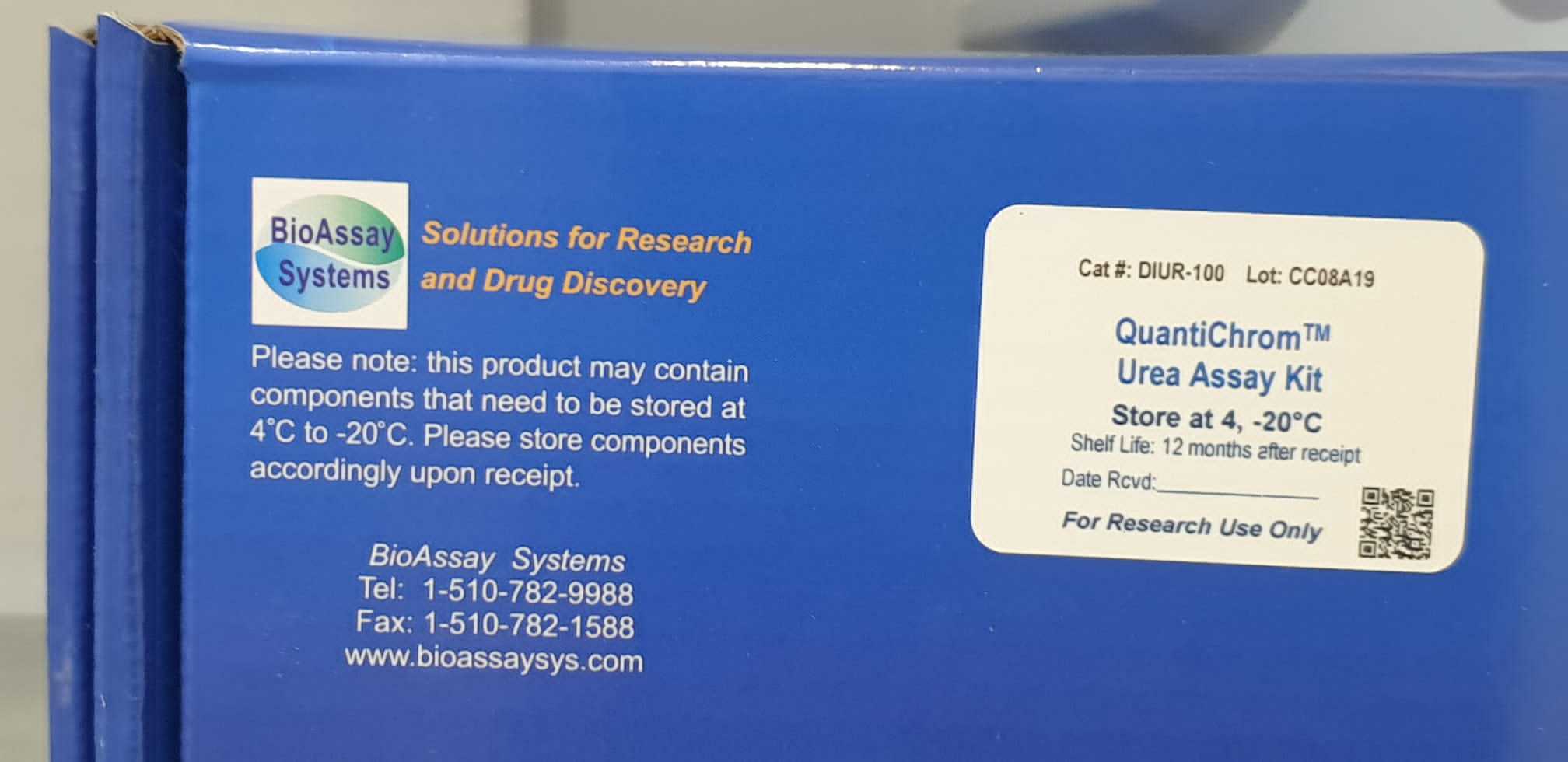
Product name: Urea test kit
Full name of the product: urea test kit
Product synonym names: urea test kit
For research use only
For research use only. It should not be used in diagnostic procedures.
Preparation and Storage
Upon receipt, aliquot and store the urea and urease standard at -20°C. Store remaining kit components at 4°C until the expiration date.
Product note
Selected information in the online data sheet is drawn from bioinformatics databases, sometimes resulting in the ambiguous or irrelevant product information. It is the customer’s responsibility to review, verify and evaluate the information to ensure it matches their requirements before purchasing the kit. Our ELISA Kit assays are dynamic research tools and can be updated and improved from time to time.
If the format of this essay is important to you, please request the current manual or contact our technical support team with a presales inquiry before placing an order. We will confirm the current trial details. We cannot guarantee that the sample manual posted online is the most up-to-date manual, it is intended to serve as an example only. Please refer to the instructions for use provided with the assay kit for precise details.
Other notes
Occasionally, small volumes of Urea Assay Kit vials may become trapped in the product vial seal during shipping and storage. If necessary, briefly centrifuge the vial in a benchtop centrifuge to dislodge any liquid on the vial cap. Certain products may require shipping with dry ice and an additional fee for dry ice may apply.
Product-related information for a urea test kit
Assay Principle: The Urea Assay Kit measures urea levels in urine, serum, plasma, cell lysates, or tissue homogenates. Samples are compared to a known concentration of urea standard within a 96-well microtiter plate format. Samples and standards are incubated for 10 minutes with the enzyme urease, which hydrolyzes urea into ammonia and CO2.
The ammonia reacts further with a chromogen in an alkaline solution to produce a blue-green product. After 30 minutes, the plate is read with a standard 96-well spectrophotometric microplate reader at an optical density between 580 nm and 630 nm (Figure 2). Higher DO values correlate with high urea concentrations. Sample urea concentrations are determined by comparison with known urea standards. The standard curve is linear up to 50 mg/dL urea.
Background/Introduction: Urea, or carbamide, is the end product of protein nitrogen metabolism and is the primary vehicle for removing toxic ammonia from the body. Urea is synthesized in the liver from ammonia produced by the catabolism of amino acids through the hepatic urea cycle. The conversion of ammonia to urea is regulated by N-acetyl glutamate, which activates carbamoyl phosphate synthetase in the urea cycle. Urea is transported in the blood to the kidneys where it is excreted in the urine. In addition to its role as a carrier of waste nitrogen, urea also plays a role in the countercurrent exchange system of the nephrons, in which water and ions are reabsorbed from excreted urine.
It is freely filtered by the glomeruli and partially passively reabsorbed as filtrate passes through the renal tubules. Urea reabsorption is inversely proportional to the urine flow rate. Consequently, the concentration of urea depends on protein intake, protein catabolism, and renal function. Urea quantification is one of the most applied tests for the evaluation of renal function. Urea analysis in serum, plasma, and urine is an important clinical test for renal disease and dysfunction. The test is often done in conjunction with creatinine determination to identify prerenal, renal, and postrenal uremia.
Toxic levels of urea are associated with renal, hepatic, or other system dysfunction. Prerenal uremia is associated with water depletion, increased protein catabolism, infection, hypovolemia, or cardiac breakdown. Glomerulonephritis, tubular necrosis, nephrosclerosis, chronic nephritis, and polycystic kidney are examples of renal uremia, while postrenal uremia predominantly consists of urinary tract obstruction or leakage. Increased urea levels may also be linked to other diseases, such as liver disease, diabetes, and congestive heart failure. High plasma urea levels are known as azotemia.
Reduced urea levels are associated with acute liver failure or excess parenteral fluid therapy. The urea test kit is based on the Berthelot reaction. The urea first breaks down into ammonia and carbon dioxide, which then reacts with an alkaline developer to produce a blue-green product that can be measured with a standard spectrophotometric plate reader at an optical density between 580 and 630 nm. Each kit provides enough reagents to perform up to 200 assays, including blanks, urea standards, and unknown samples and controls.
Precautions
All MyBioSource products are for scientific laboratory research purposes and not for diagnostic, therapeutic, prophylactic, or in vivo use. Through your purchase, you expressly represent and warrant to MyBioSource that you will properly test and use any Product purchased from MyBioSource in accordance with industry standards. MyBioSource and its authorized distributors reserve the right to refuse to process any order where we reasonably believe that the intended use will not meet our acceptable guidelines.
Disclaimer
While every effort has been made to ensure the accuracy of the information provided in this datasheet, MyBioSource will not be responsible for any omissions or errors contained herein. MyBioSource reserves the right to make changes to this datasheet at any time without notice.